
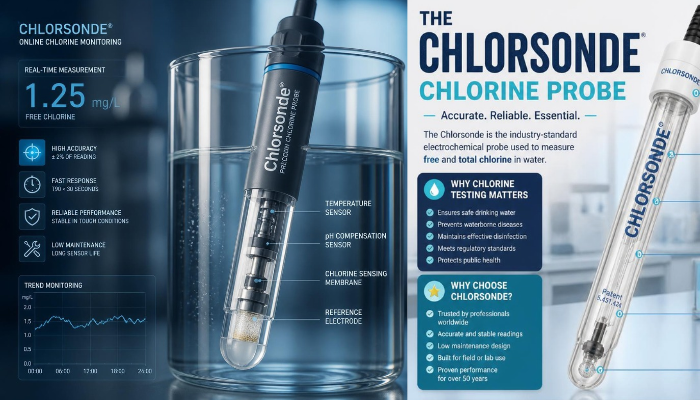

A Chlorsonde is a chlorine probe or chlorine sensor used to monitor chlorine levels in water. The term is commonly found in German technical documentation, especially for swimming-pool water treatment and automatic dosing systems. In English, the closest terms are chlorine probe, chlorine sensor, or free chlorine sensor.
The important point is that not every water-treatment probe measures chlorine in the same way. Some sensors measure free chlorine directly, while ORP or Redox probes measure the oxidation-reduction potential of the water and use that value as an indicator of disinfecting conditions. Understanding this difference is essential when choosing, calibrating, or troubleshooting a chlorine monitoring system.
What Is a Chlorsonde?
Chlorsonde means a chlorine probe or chlorine sensor. It is an electrochemical measuring device designed to monitor chlorine in water.
These sensors are commonly integrated into automated water-treatment equipment. A controller receives the sensor’s measurement and can use it to monitor water chemistry or control a chemical dosing system.
In a swimming pool, for example, a chlorine probe may be installed in a sample-water line or measuring chamber. The probe detects the chlorine level and sends a signal to the controller. Depending on the system design, the controller can then adjust chlorine dosing.
The exact measurement method depends on the sensor. Some chlorine probes use amperometric or potentiostatic electrochemical measurement, while other systems use ORP sensors that measure oxidation-reduction potential rather than chlorine concentration itself.
That distinction is one of the most important things to understand when researching a Chlorsonde.
What Does a Chlorine Probe Measure?
A chlorine probe can be designed to measure a specific chlorine parameter, most commonly free chlorine.
Free chlorine is the portion of chlorine available to provide sanitizing action in treated water. Some advanced systems can also measure or calculate other chlorine-related parameters, including total and combined chlorine.
The measurement is commonly displayed in:
- ppm
- mg/L
- or another unit specified by the controller
For water, 1 mg/L is numerically equivalent to 1 ppm under ordinary reporting conditions.
However, you should not assume that every sensor labeled as a chlorine probe measures exactly the same thing. The sensor’s specifications should identify whether it measures free chlorine, total chlorine, combined chlorine, or another parameter.
For example, commercial chlorine-monitoring equipment can use different sensor designs for free chlorine and total chlorine. Some systems calculate combined chlorine from total chlorine and free chlorine measurements.
How Does a Chlorine Sensor Work?
Many direct chlorine sensors use an electrochemical measurement principle.
In a typical amperometric chlorine sensor, the water comes into contact with an electrode system. The chemical reaction involving the disinfectant produces an electrical response. The electronics convert that response into a reading representing the chlorine concentration.
A more advanced potentiostatic design can use multiple electrodes and controlled electrical conditions to improve measurement stability.
The basic process is:
- Water reaches the sensor.
- Chlorine interacts with the sensing system.
- An electrochemical signal is generated.
- The sensor electronics interpret that signal.
- The controller converts the signal into a chlorine reading.
- The controller can display the value or use it for automated dosing.
The exact construction differs between manufacturers and sensor models. Some commercial free-chlorine sensors use three-electrode amperometric designs and may include temperature compensation.
What Is an Amperometric Chlorine Probe?
An amperometric chlorine probe measures chlorine through an electrochemical current generated by the reaction at the sensing electrode.
This technology is widely used where continuous chlorine measurement is required.
One advantage is that a suitable direct chlorine sensor can provide a measurement of free chlorine concentration rather than simply measuring the overall oxidation potential of the water.
Manufacturer documentation for pool systems describes amperometric probes as devices used to continuously measure free chlorine in ppm.
However, amperometric sensors are not maintenance-free. Their performance can depend on installation conditions, water flow, sensor condition, calibration, and the specific chemistry for which the sensor was designed.
This means that buying a high-quality sensor does not remove the need for proper setup and verification.
Chlorsonde vs. ORP Sensor
A chlorine probe and an ORP sensor are related, but they are not the same type of measurement.
| Feature | Chlorine Probe | ORP/Redox Probe |
|---|---|---|
| Primary measurement | Chlorine concentration, depending on sensor | Oxidation-reduction potential |
| Typical unit | ppm or mg/L | mV |
| Direct chlorine measurement | Yes, with a suitable chlorine sensor | No |
| Influenced by pH | Depending on sensor design | Yes |
| Can support automatic control | Yes | Yes |
| Calibration method | Often compared with a reference chlorine test | Depends on sensor/system |
| Best described as | Concentration measurement | Oxidation potential measurement |
An ORP sensor responds to the oxidizing potential of the water. It does not specifically identify chlorine concentration because other oxidizing substances can influence the measurement. PWTAG also notes that ORP readings are affected by pH.
This explains why two systems can produce different types of readings even when they are being used to manage the same swimming pool.
Why does this difference matter?
Suppose a controller displays 700 mV.
That is an ORP value, not a direct statement that the pool contains a specific number of ppm of free chlorine.
If another controller displays 1.5 ppm free chlorine, that is a concentration measurement.
The two numbers should not be treated as interchangeable.
Why Does pH Matter When Measuring Chlorine?
pH is one of the most important factors in chlorine-based water treatment.
Chlorine chemistry changes as pH changes. This affects how effectively chlorine acts as a disinfectant and can also affect the relationship between chlorine concentration and ORP.
This is particularly important when using ORP control.
An ORP probe does not simply ask, “How much chlorine is present?” It responds to the overall electrochemical conditions of the water. Changes in pH can therefore change the ORP reading even when the measured chlorine concentration does not change in the same way.
For this reason, automated pool systems commonly monitor both pH and disinfection parameters. Modern systems may combine pH sensors with ORP or direct free-chlorine sensors.
Where Are Chlorine Probes Used?
Chlorsonde-type sensors can be used in many water-treatment applications.
Swimming pools
Swimming pools are one of the most recognizable applications.
An automated system can monitor chlorine and use the information to help maintain the desired water chemistry.
Commercial pools
Hotels, fitness centers, aquatic facilities, and other commercial operations may need continuous monitoring rather than relying exclusively on occasional manual testing.
Commercial systems can combine chlorine sensors with pH, temperature, flow, and other measurements.
Water-treatment systems
Chlorine monitoring is also relevant in water-treatment processes where a disinfectant residual needs to be monitored.
The correct sensor depends on the water chemistry, disinfectant, required measurement range, and system design.
Industrial applications
Some industrial processes require continuous monitoring of disinfectant concentration. In these applications, sensor selection becomes more specialized because contaminants, temperature, flow, and other chemical conditions can affect sensor performance.
How Is a Chlorine Probe Calibrated?
Calibration means adjusting the measurement system so that its reading agrees with a trusted reference measurement.
The exact procedure depends on the sensor and controller. You should always follow the manufacturer’s instructions because chlorine probes do not all use the same calibration process.
A common approach for free-chlorine measurement is to compare the sensor reading with a reliable reference test, such as a DPD-based measurement.
For example, a controller manual may instruct the operator to take a water sample, measure free chlorine with a reference method, and then adjust the displayed sensor value to match the reference result.
Basic calibration concept
The general process looks like this:
- Make sure the water is circulating correctly.
- Confirm that the sensor has reached stable operating conditions.
- Take a representative water sample.
- Measure the chlorine concentration with the recommended reference method.
- Compare the reference result with the sensor reading.
- Adjust the sensor according to the controller’s calibration procedure.
- Allow the reading to stabilize.
- Verify the result again.
Some sensors require a stabilization or polarization period before calibration. Technical manuals can specify waiting periods ranging from several hours to longer periods depending on the sensor and system.
Therefore, calibration should never be rushed simply because the controller has a calibration menu.
How Often Should a Chlorine Probe Be Checked?
There is no single universal calibration schedule that applies to every Chlorsonde.
The appropriate interval depends on:
- Sensor type
- Manufacturer
- Water chemistry
- Operating temperature
- Flow conditions
- Sensor age
- Amount of contamination
- Controller design
- Importance of measurement accuracy
A commercial pool with strict monitoring requirements may need a more structured verification program than a small residential pool.
The safest approach is to follow the manufacturer’s maintenance schedule and periodically compare the automated reading with an appropriate independent test.
If the readings begin drifting, do not assume that the sensor simply needs calibration. The cause could also be flow, contamination, wiring, water chemistry, sensor aging, or another system problem.
Common Chlorine Probe Problems
A Chlorsonde can produce an incorrect or unstable reading for several reasons.
1. Dirty sensor
Deposits, biofilm, oils, or other contamination can interfere with the sensor’s measurement surface.
Cleaning should be performed according to the manufacturer’s instructions. Aggressive cleaning methods can damage sensitive electrodes or membranes.
2. Incorrect water flow
Many chlorine sensors require a specific flow rate.
If water does not pass the sensor correctly, the reading may become unstable or inaccurate.
Some equipment manuals specify a defined sample-water flow range for chlorine probes.
3. Poor calibration
If the reference test is inaccurate or calibration is performed before the sensor has stabilized, the controller may display an incorrect chlorine value.
4. Sensor aging
Electrochemical sensors can degrade over time.
A sensor that previously worked correctly may eventually become slow, unstable, or difficult to calibrate.
5. Incorrect installation
The sensor needs to be installed according to its manufacturer’s requirements.
Installation orientation, sample flow, electrical connections, and the measuring chamber can all affect performance.
6. Water chemistry problems
Large changes in pH, temperature, stabilizer concentration, or other water parameters can affect chlorine measurement or its interpretation.
7. Electrical or communication problems
A good sensor can still appear faulty if its cable, connector, controller input, or communication connection has a problem.
How to Troubleshoot an Incorrect Chlorine Reading
If your Chlorsonde is showing a value that appears wrong, use a systematic approach.
Step 1: Verify the water sample
Before changing the sensor settings, test the water with an appropriate independent method.
This establishes whether the sensor or the water chemistry is actually the problem.
Step 2: Check flow
Confirm that water is reaching the probe at the correct rate.
A restricted line, air pocket, blocked filter, or circulation problem can affect the reading.
Step 3: Inspect the probe
Look for:
- Deposits
- Dirt
- Damage
- Air bubbles
- Membrane problems
- Loose connections
Step 4: Check pH and temperature
Unexpected water chemistry can affect sensor behavior and the relationship between chlorine and ORP.
Step 5: Check calibration
If the independent reference measurement is reliable but the sensor differs significantly, follow the manufacturer’s calibration procedure.
Step 6: Check the electrical connection
Inspect the cable and connector for visible damage or loose connections.
Step 7: Consider sensor replacement
If the sensor cannot stabilize or calibrate despite correct flow, clean water, proper installation, and a correct calibration procedure, the probe itself may need replacement.
Chlorine Probe Maintenance
Proper maintenance can help keep a chlorine sensor reliable.
A basic maintenance routine may include:
- Inspecting the sensor regularly
- Keeping the measuring chamber clean
- Maintaining correct sample flow
- Checking for air bubbles
- Verifying readings against a reference test
- Following the manufacturer’s cleaning instructions
- Checking cables and connectors
- Recalibrating when required
- Replacing consumable sensor components when specified
Do not use a generic cleaning chemical simply because it works on another type of pool equipment. The sensing element can be sensitive to mechanical and chemical damage.
The manufacturer’s maintenance instructions should always take priority.
How to Choose a Replacement Chlorine Probe
Replacing a Chlorsonde is not simply a matter of searching for “chlorine sensor” and choosing the cheapest option.
The replacement needs to be compatible with the existing controller and water-treatment system.
Check these specifications before buying:
Measurement type
Determine whether your existing system measures:
- Free chlorine
- Total chlorine
- Combined chlorine
- ORP
- Another parameter
An ORP probe is not automatically a replacement for a direct chlorine sensor.
Measurement range
Check the sensor’s operating range and compare it with the range required by your application.
Output type
The controller may require a particular electrical or communication interface.
Examples can include:
- Analog current output
- Voltage signal
- Digital communication
- Proprietary connector
Installation requirements
Check:
- Probe diameter
- Connection type
- Mounting method
- Installation orientation
- Sample flow requirements
Water chemistry compatibility
Make sure the sensor is designed for the water you’re monitoring.
A probe designed for one application may not perform correctly in another.
Temperature range
Temperature can affect electrochemical measurements, and some sensors provide temperature compensation.
Check the manufacturer’s specifications before selecting a replacement.
Controller compatibility
This is especially important.
Even if two probes look almost identical, their electrical characteristics and calibration requirements may be different.
When possible, identify the exact model number of the old sensor and check the replacement against the controller manufacturer’s compatibility information.
Chlorine Probe vs. Manual DPD Testing
Automatic chlorine monitoring does not necessarily eliminate manual testing.
A sensor provides continuous information while the circulation system is operating, whereas a manual test provides an independent measurement at a particular moment.
DPD testing is widely used as a reference method for measuring chlorine in pool-water applications, and some equipment manufacturers specifically instruct users to compare the chlorine probe reading with a DPD result during calibration.
The two approaches serve different purposes.
| Method | Main advantage | Main limitation |
|---|---|---|
| Chlorine probe | Continuous monitoring | Requires correct installation and maintenance |
| DPD test | Independent spot measurement | Does not continuously monitor water |
| ORP probe | Continuous oxidation-potential measurement | Does not directly measure chlorine concentration |
| Test strips | Quick and convenient | Generally less suitable for precise automated control |
For an automated system, independent testing can be useful for checking whether the sensor is still behaving correctly.
Is a Chlorsonde Worth Using?
A chlorine probe can be valuable when continuous monitoring and automated control are important.
It can be particularly useful for:
- Automated pool systems
- Commercial pools
- Facilities with high bather loads
- Systems using automatic chemical dosing
- Applications where water chemistry needs frequent monitoring
- Operators who want real-time sensor data
For a simple residential pool, however, the cost and maintenance requirements may not always justify a direct chlorine sensor.
The right choice depends on the size of the pool, the automation system, how frequently the water is used, the required monitoring accuracy, and the operator’s willingness to maintain the equipment.
What Is the Difference Between a Chlorsonde and a Chlorine Analyzer?
The terms can overlap, but they generally describe different parts of a monitoring system.
A Chlorsonde is the sensing component.
A chlorine analyzer is usually the larger system that may include the sensor, electronics, display, sample system, calibration functions, and control outputs.
In simple terms:
Chlorsonde = sensor
Chlorine analyzer = complete measurement system
The terminology can vary between manufacturers, so specifications should be checked rather than relying solely on the product name.
Can a Chlorsonde Control Chlorine Dosing?
Yes, a chlorine sensor can be integrated into an automatic dosing system when the controller supports that type of sensor.
The basic control loop can work like this:
Water → Chlorine sensor → Controller → Dosing decision → Pump or chlorine-generation system → Water
If the measured value moves outside the configured control range, the controller can respond according to its programming.
Some systems combine chlorine measurement with pH measurement and other safety controls. Modern pool-control equipment can use free-chlorine sensors, ORP sensors, pH probes, temperature sensors, and flow monitoring as part of an automated water-treatment system.
The actual control strategy depends on the equipment manufacturer and application.
Why Can Two Chlorine Systems Give Different Readings?
Different systems can produce different readings because they may be measuring different things.
For example:
- A direct free-chlorine sensor reports chlorine concentration.
- An ORP probe reports oxidation-reduction potential.
- A DPD test measures chlorine through a chemical color reaction.
- Test strips provide a visual estimate.
Even when two methods are intended to monitor the same pool, their values should not be expected to match numerically.
Water chemistry also changes continuously. pH, temperature, chlorine demand, stabilizer, contaminants, and other factors can influence measurements and the effectiveness of the disinfection process.
What Should You Check Before Buying a Chlorsonde?
Before ordering a replacement chlorine probe, collect the following information:
1. Existing sensor model:
Look for the model number printed on the probe.
2. Controller model:
Identify the exact controller or dosing system.
3. Measurement type:
Confirm whether the system measures free chlorine, total chlorine, ORP, or another parameter.
4. Connection:
Check the connector and electrical interface.
5. Measuring range:
Confirm that the replacement covers your required range.
6. Installation method:
Check dimensions, mounting, flow requirements, and orientation.
7. Water type:
Confirm whether the sensor is designed for fresh water, salt water, or the specific chemical environment in your system.
8. Calibration requirements:
Check whether the sensor requires DPD comparison, zero calibration, gain calibration, or another procedure.
These details can prevent a common mistake: purchasing a probe that looks compatible but cannot communicate correctly with the controller.
Final Takeaway
A Chlorsonde is essentially a chlorine probe or chlorine sensor, with the German term appearing frequently in technical documentation for pool and water-treatment equipment.
The most important distinction is between a direct chlorine sensor and an ORP/Redox sensor. A direct chlorine probe can measure chlorine concentration, commonly free chlorine, while an ORP sensor measures the oxidation-reduction potential of the water and does not directly report chlorine concentration.
For reliable operation, a chlorine probe needs more than a correct installation. Flow, calibration, sensor condition, water chemistry, temperature, and controller compatibility all matter.
If you’re trying to replace a Chlorsonde, identify the exact sensor and controller model before purchasing. If you’re trying to understand an unusual chlorine reading, verify it with an appropriate independent test before recalibrating or replacing the probe.
What does Chlorsonde mean?
Chlorsonde is a German term for a chlorine probe or chlorine sensor. It is commonly used in technical documentation for swimming-pool and water-treatment systems.
Is a Chlorsonde the same as a chlorine sensor?
Yes, in general usage, Chlorsonde refers to a chlorine probe or chlorine sensor. The exact type of chlorine measurement depends on the sensor design.
Does a Chlorsonde measure free chlorine?
Many chlorine probes are designed to measure free chlorine, but not every chlorine-related sensor measures the same parameter. Always check the manufacturer’s specifications.
Is a chlorine probe the same as an ORP probe?
No. A direct chlorine probe can measure chlorine concentration, while an ORP probe measures oxidation-reduction potential in millivolts. ORP is influenced by pH and other water conditions.
How is a chlorine probe calibrated?
Calibration varies by sensor. A common approach is to compare the probe reading with an independent chlorine measurement, such as a DPD test, and then adjust the controller according to the manufacturer’s instructions.
Why is my chlorine probe reading wrong?
Possible causes include dirty sensing surfaces, incorrect water flow, poor calibration, sensor aging, incorrect installation, water chemistry changes, air bubbles, or electrical problems.
Can a chlorine probe control an automatic dosing pump?
Yes. When compatible with the controller, a chlorine probe can provide measurements that an automated system uses to control chlorine dosing.
How long does a chlorine probe last?
There is no universal lifespan for every chlorine probe. Service life depends on sensor design, water chemistry, operating conditions, maintenance, and manufacturer specifications.
Do I still need manual chlorine testing if I have a chlorine probe?
Manual testing can still be useful as an independent verification method. It can help identify whether a sensor is drifting or requires maintenance.
What should I check when replacing a Chlorsonde?
Check the sensor model, controller compatibility, measurement type, measuring range, electrical connection, installation requirements, water chemistry compatibility, and calibration procedure.
See also: MPS Engineering & Construction: Commercial Construction in South Carolina