
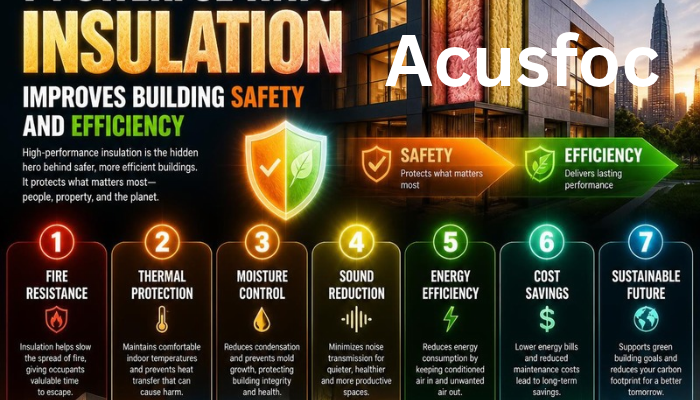

Acusfoc is a Valencia-based company specializing in fireproofing, acoustic insulation, and thermal insulation for the building and industrial sectors. Its work covers solutions designed to improve fire resistance, indoor comfort, energy performance, and protection against unwanted noise. The company states that it has more than 15 years of experience in insulation and fireproofing and works with both construction and industrial projects.
Insulation isn’t simply about making a building warmer in winter or cooler in summer. A well-designed insulation system can also contribute to fire safety, acoustic comfort, durability, and compliance with applicable Spanish construction requirements.
For property owners, architects, contractors, industrial operators, and developers in Valencia, choosing the right insulation approach can make a meaningful difference throughout a building’s service life.
This guide explains the main insulation areas associated with modern construction, how fireproofing and acoustic systems work, which materials may be used, and why proper installation matters.
1. Why Insulation Matters in Modern Construction
Insulation has become an important part of modern building design because buildings need to perform well in several areas at the same time. A wall, roof, floor, or structural element may need to provide thermal protection, acoustic comfort, moisture control, and fire performance depending on its location and purpose.
In Spain, these requirements are addressed through the Código Técnico de la Edificación (CTE) and its different Basic Documents. The CTE covers areas including fire safety, protection against noise, energy saving, structural safety, accessibility, and health.
Thermal Performance
Thermal insulation reduces unwanted heat transfer through the building envelope. During hot weather, an effective system can help limit heat entering a building. During colder periods, it can help retain indoor heat.
This matters particularly in Valencia and other Mediterranean locations, where buildings can experience significant summer heat and strong solar exposure.
Acusfoc describes several thermal insulation applications, including facades, cavities, roofs, and other building elements. Its published solutions include rock wool mortar, polyurethane foam, and reflective thermal coating systems.
The right solution depends on the construction system, available space, required thermal performance, moisture conditions, and installation method.
Acoustic Comfort
Noise can have a major impact on the usability of homes, offices, hotels, schools, healthcare facilities, and industrial buildings.
Acoustic insulation aims to reduce the transmission of unwanted sound between spaces or from external sources. Depending on the project, this can involve walls, ceilings, floors, facades, mechanical equipment, pipes, or other building elements.
Spain’s CTE includes DB-HR Protection against Noise, which establishes requirements and procedures for acoustic protection in buildings.
A good acoustic design considers more than simply adding thick insulation. Flanking transmission, structural connections, doors, windows, service penetrations, and installation quality can all affect the final result.
Fire Protection
Fire safety is another critical reason for using specialized insulation systems.
Certain construction materials and protective coatings can delay the effects of fire on structural elements. This may help maintain structural stability for a specified period, depending on the tested and certified system.
Acusfoc states that its fireproofing services include protection of metal structures and construction enclosures and that its solutions are designed to increase fire resistance and stability.
The Spanish CTE includes DB-SI Safety in Case of Fire, which establishes rules and procedures related to fire safety in buildings.
The important point is simple: insulation should be selected according to the actual requirements of the building rather than based solely on material price or thickness.
2. Fireproofing Solutions for Buildings and Industry
Fireproofing is particularly important where structural elements or building components must maintain their performance when exposed to elevated temperatures.
Steel structures are a common example. Steel doesn’t burn in the same way as combustible materials, but its mechanical properties can be affected significantly by high temperatures. A suitable passive fire protection system can help delay the temperature rise of the protected element.
Structural Steel Protection
Industrial warehouses, commercial buildings, public facilities, and other structures may contain substantial amounts of exposed or concealed steel.
Fire protection for these structures can involve different systems depending on the project specification, required fire-resistance period, geometry, environmental conditions, and finishing requirements.
Acusfoc lists solutions including mineral fibre or rock wool mortar, intumescent paint, ablative ceramic paint, vermiculite mortar, gypsum-based mortar, and fire-resistant panels.
Each material has different characteristics.
For example:
- Intumescent coatings expand when exposed to high temperatures and form an insulating layer.
- Mineral fibre or rock wool systems can provide thermal resistance and fire protection.
- Fire-resistant panels can create a protective enclosure around structural components.
- Specialized mortars can be applied to protect steel structures and other elements.
- Fire-resistant sealants can protect penetrations and joints where services pass through fire-rated assemblies.
Common Fireproofing Materials
Material selection should always be based on the complete construction system and its documented performance.
A product that performs well in one application may not be suitable for another. Thickness, substrate preparation, application technique, environmental exposure, and detailing can all affect performance.
For this reason, professional assessment is important before selecting a fireproofing system.
Fire-Stopping Details
One of the easiest areas to overlook is the treatment of service penetrations.
Electrical cables, ventilation ducts, pipes, and other installations often pass through walls and floors. If these openings aren’t properly protected, they can compromise the fire performance of an otherwise well-designed compartment.
Fire-resistant collars, sealants, and other tested systems can be used for appropriate service penetrations.
Acusfoc specifically identifies intumescent collars and mastics among the materials used for sealing installation penetrations.
Passive Fire Protection Is Part of a Larger Strategy
Fireproofing isn’t a replacement for alarms, sprinklers, emergency exits, firefighting systems, or evacuation planning. Instead, passive fire protection forms one part of an integrated fire-safety strategy.
The objective is to help construction elements and fire compartments perform as required during a fire event.
The official CTE documentation should always be consulted for the requirements applicable to a particular project because Spanish regulations and technical documents can be updated over time. The official CTE website provides current documentation for DB-SI and related fire-safety materials.
3. Thermal Insulation for Energy Efficiency
Thermal insulation can improve building comfort while supporting energy-efficiency objectives.
A building envelope is exposed to outdoor conditions every day. Roofs receive solar radiation, facades exchange heat with the exterior, and poorly insulated cavities can contribute to unwanted heat transfer.
Roofs and Ceilings
Roofs can play a major role in the thermal performance of a building, particularly in areas exposed to strong sunlight.
Insulation can be installed using different approaches depending on whether the project is new construction, renovation, or an industrial application.
A suitable system can reduce heat transfer between the exterior and interior. However, designers must consider the complete roof assembly rather than treating insulation as an isolated layer.
Factors such as moisture, ventilation, waterproofing, structural loading, and thermal bridges can influence the result.
Facades and Cavities
External walls and cavity spaces are another important area.
Acusfoc describes thermal insulation applications for facades and cavities using several types of systems, including projected rock wool mortar and polyurethane foam.
The correct choice depends on the existing or planned construction.
For example, renovation projects may have limited cavity space, while new construction can often incorporate insulation into the wall assembly during design.
Spray Insulation Systems
Spray-applied insulation can be useful where continuous coverage is required or where irregular surfaces make traditional installation difficult.
Polyurethane foam is one example used for certain thermal insulation applications. Its suitability depends on the substrate, application environment, required performance, fire classification, moisture exposure, and project specifications.
Professional application is particularly important with sprayed systems because the finished performance depends on correct preparation, equipment settings, thickness, coverage, and curing conditions.
Reflective Coatings
Some projects may also use reflective coatings designed to reduce surface temperatures by reflecting solar radiation.
Acusfoc describes Eurotermik projected paint as a system intended to reduce the temperature of surfaces exposed to sunlight and notes its high solar reflectivity.
Such coatings shouldn’t automatically be considered a substitute for conventional thermal insulation. They serve a different function and should be evaluated as part of the complete building-envelope design.
Energy Performance and Spanish Requirements
Energy efficiency is directly addressed by CTE DB-HE, which establishes requirements and procedures related to energy saving.
The official CTE framework also includes tools for assessing building energy performance and construction characteristics.
For a real project, thermal insulation should therefore be selected with the overall envelope, energy targets, climate conditions, and regulatory requirements in mind.
4. Acoustic Insulation and Soundproofing
Good acoustic performance can make buildings noticeably more comfortable.
The objective isn’t always to make a room completely silent. Instead, acoustic design normally aims to control unwanted sound and achieve an appropriate level of separation or absorption for the intended use.
Airborne Noise
Airborne noise travels through the air and can move between rooms through walls, doors, ceilings, windows, and gaps.
Examples include:
- Conversations
- Television and music
- Traffic
- Industrial machinery
- Commercial activity
- HVAC equipment
Wall and ceiling assemblies can be designed to reduce sound transmission.
However, the insulation material is only one component. The mass and construction of the separating element, cavities, connections, and openings can all influence acoustic performance.
Impact Noise
Impact noise occurs when physical activity generates vibration.
Footsteps are a common example.
In multi-storey buildings, floor construction can therefore be just as important as wall construction. Floating floor systems, resilient layers, and acoustic underlays may be considered depending on the project.
The CTE’s DB-HR framework addresses acoustic protection, including different acoustic characteristics of building elements.
Building Services Noise
Pipes, pumps, ventilation equipment, elevators, and mechanical systems can create unwanted noise and vibration.
A building may have excellent wall insulation but still experience poor acoustic comfort if mechanical systems transmit vibration through the structure.
This is why acoustic design should consider the building as a complete system.
Acoustic Measurements
Measurement can be useful when diagnosing an existing problem or verifying performance.
Acusfoc lists acoustic measurements among its services and provides a dedicated contact for acoustic insulation and measurements.
Testing can help identify where a sound problem originates and whether additional treatment is required.
Designing for the Actual Noise Source
A common mistake is choosing insulation before understanding the noise.
A good assessment asks several questions:
- Where does the noise originate?
- Is it airborne or impact noise?
- Is it travelling directly or through another building element?
- Are there gaps or penetrations?
- Are mechanical vibrations involved?
- What level of acoustic separation is required?
Answering these questions first can prevent unnecessary work and help create a more targeted solution.
5. Materials Used in Insulation Projects
There is no single insulation material that is ideal for every application.
Material selection should consider thermal properties, fire performance, acoustic requirements, moisture exposure, installation conditions, durability, cost, and the requirements of the construction assembly.
Rock Wool
Rock wool is widely associated with thermal and acoustic insulation and can also provide useful fire-performance characteristics.
Acusfoc describes projected rock wool mortar as a solution for thermal and acoustic insulation of roofs, facades, and cavities, while also describing it as non-combustible.
Its suitability still depends on the complete system and the requirements of the specific project.
Polyurethane Foam
Polyurethane foam can provide effective thermal insulation in suitable applications.
It can be used in cavities, facades, and roofs under appropriate conditions. Acusfoc lists polyurethane foam among its thermal insulation solutions in Valencia.
As with any construction material, the product specification and installation method matter.
Intumescent Coatings
Intumescent coatings are designed primarily for passive fire protection applications.
When exposed to elevated temperatures, the coating can expand and form a protective char layer. This layer helps slow heat transfer to the protected substrate.
Correct application is essential because performance depends on factors such as dry film thickness, substrate preparation, coating compatibility, and environmental exposure.
Fire-Resistant Panels
Fire-resistant panels can provide a practical method of protecting structural elements or creating fire-rated assemblies.
They can be especially useful where a defined enclosure or lining system is appropriate.
The selected panel must be suitable for the intended application and installed according to its tested system requirements.
Material Selection Table
| Material/System | Typical Application | Main Consideration |
|---|---|---|
| Rock wool | Thermal, acoustic and fire-related applications | Assembly and fire classification |
| Polyurethane foam | Cavities, roofs and facades | Thermal performance and application |
| Intumescent coating | Steel fire protection | Correct thickness and preparation |
| Fire-resistant panels | Enclosures and protection | Tested assembly requirements |
| Specialized mortars | Structural fire protection | Application thickness and substrate |
| Intumescent sealants | Penetrations and joints | Correct detailing |
The table provides a general guide. A professional assessment is still required before specifying a particular product or system.
6. Spanish Regulations and Construction Standards
Insulation projects in Spain must be considered within the applicable regulatory framework.
The Código Técnico de la Edificación is the country’s official technical framework for many building requirements. Its structure includes separate Basic Documents dealing with fire safety, noise protection, energy saving, and other areas.
DB-SI: Fire Safety
DB-SI addresses safety in case of fire.
It establishes rules and procedures designed to meet basic fire-safety requirements in buildings. The official CTE website currently provides the applicable DB-SI documentation and related support documents.
For fireproofing work, project documentation should therefore be reviewed before selecting or applying a protection system.
DB-HR: Acoustic Protection
DB-HR focuses on protection against noise.
It provides requirements and procedures for achieving acoustic performance in buildings. The official application guide also provides practical guidance for professionals involved in design, construction, and control.
This is particularly relevant to residential buildings, hotels, offices, educational facilities, and other properties where acoustic comfort matters.
DB-HE: Energy Saving
DB-HE addresses energy saving.
Thermal insulation forms an important part of building-envelope performance, so designers need to consider insulation alongside other energy-related characteristics.
The CTE provides official DB-HE documents and supporting resources, including material related to thermal bridges and condensation assessment.
Why Current Documentation Matters
Construction regulations can change.
For that reason, contractors and designers shouldn’t rely indefinitely on an old project document, product sheet, or online article.
The official CTE website is the appropriate reference point for current Spanish technical documentation.
7. Why Professional Installation Matters
Even a high-quality insulation material can perform poorly if it isn’t installed correctly.
This is particularly important for fireproofing because the performance of a fire-resistance system may depend on the complete tested configuration.
Project Assessment
A professional assessment should consider:
- Building type
- Construction materials
- Structural elements
- Existing insulation
- Moisture conditions
- Fire requirements
- Acoustic requirements
- Thermal targets
- Access to the work area
- Installation conditions
- Applicable regulations
This information helps determine which system is appropriate.
Installation Quality
Application quality can affect both performance and durability.
For example, an uneven fireproof coating may not provide the required protection. Gaps in acoustic insulation can create unwanted sound paths. Poorly installed thermal insulation can create thermal bridges.
Attention to detail is therefore essential.
Verification and Documentation
Documentation is another important part of professional construction work.
Acusfoc states that it provides certification and documentation after its fireproofing work in accordance with applicable requirements. It also states that the company is registered with Spain’s Register of Accredited Companies in Construction and ROLECE.
Such documentation can be valuable for project records, compliance checks, maintenance, and future building management.
Choosing an Insulation Contractor
When comparing contractors, don’t focus only on the quoted price.
Consider:
- Relevant project experience
- Technical qualifications
- Knowledge of Spanish requirements
- Material documentation
- Installation procedures
- Safety practices
- Testing and measurement capabilities
- Project references
- Post-installation documentation
Acusfoc describes its work as covering the building and industrial sectors and lists fireproofing, thermal insulation, acoustic insulation, and acoustic measurements among its services.
For a project in Valencia, these factors can help property owners and construction professionals evaluate whether a proposed insulation solution matches their technical requirements.
Frequently Asked Questions
1. What does Acusfoc specialize in?
Acusfoc specializes in fireproofing, thermal insulation, and acoustic insulation for building and industrial applications. The company is based in Valencia and states that it has more than 15 years of experience in the insulation sector.
2. What types of fireproofing does Acusfoc provide?
According to its published service information, Acusfoc works with solutions including mineral fibre or rock wool mortar, intumescent paint, ablative ceramic paint, vermiculite and gypsum-based mortars, fire-resistant panels, and intumescent collars and mastics.
3. Can thermal insulation improve building comfort?
Yes. Thermal insulation reduces unwanted heat transfer between indoor and outdoor environments. The exact improvement depends on the building envelope, insulation system, climate, installation quality, windows, ventilation, and other factors.
4. Is acoustic insulation the same as soundproofing?
The terms are often used interchangeably in everyday conversation, but acoustic treatment can involve several different objectives. Insulation generally focuses on reducing sound transmission between spaces, while acoustic treatment can also involve controlling reverberation and sound reflection inside a room.
5. What is DB-SI?
DB-SI is the Spanish CTE Basic Document concerning safety in case of fire. It establishes rules and procedures for meeting basic fire-safety requirements in buildings.
6. What is DB-HR?
DB-HR is the CTE Basic Document concerning protection against noise. It establishes requirements and procedures related to acoustic protection in buildings.
7. What is DB-HE?
DB-HE is the CTE Basic Document concerning energy saving. It establishes requirements and procedures related to energy performance in buildings.
8. Why are fire-resistant seals important?
Service penetrations can create openings through otherwise protected walls and floors. Appropriate fire-stopping products, such as tested collars or sealants, can help maintain the intended fire performance of the construction assembly.
9. Should insulation be selected based only on price?
No. The cheapest material may not provide the required thermal, acoustic, fire, moisture, or durability performance. Selection should be based on the requirements of the complete construction system.
10. Where can I find current Spanish building requirements?
The official Código Técnico de la Edificación website provides current CTE documents, Basic Documents, supporting documents, and related technical resources.
Conclusion
Insulation is much more than a comfort feature. In modern construction, it can contribute to thermal efficiency, acoustic comfort, passive fire protection, and overall building performance.
For projects in Valencia and across Spain, the correct solution depends on the building type, construction system, intended use, technical requirements, and applicable regulations.
Acusfoc focuses on three major areas: fireproofing, thermal insulation, and acoustic insulation. Its published services cover both building and industrial applications, with solutions ranging from rock wool and polyurethane systems to intumescent coatings, fire-resistant panels, and acoustic measurement services.
The most important step is to treat insulation as part of the complete building design. Proper assessment, material selection, installation, testing, and documentation all contribute to a successful result.
For anyone planning a construction, renovation, industrial, fireproofing, thermal, or acoustic project in Valencia, a professional assessment can help determine which solution is appropriate for the specific building and its requirements.