
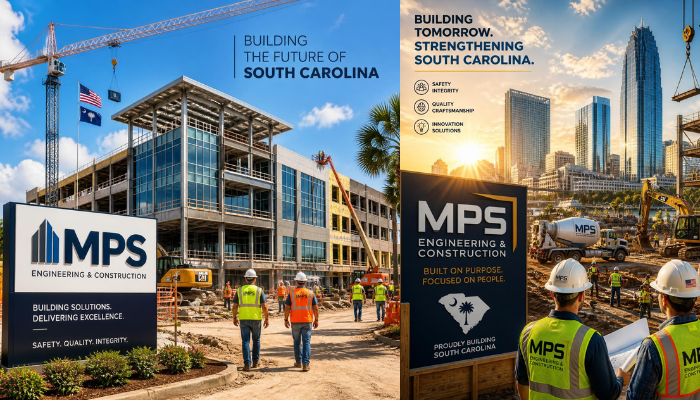

MPS Engineering & Construction is a Mount Pleasant, South Carolina-based engineering and construction firm serving businesses and organizations throughout the Lowcountry. The company describes itself as a full-service commercial construction firm, with capabilities spanning pre-construction planning, general contracting, design-build, project management, renovations, and site development. Its stated service area includes Charleston, Berkeley, and Dorchester counties, giving it a distinctly regional focus rather than a one-city-only footprint.
For a business owner, developer, property manager, institution, or organization planning a construction project, that combination matters. Commercial construction is rarely just about putting up walls and installing equipment. A successful project requires decisions about scope, budget, scheduling, permitting, constructability, subcontractors, materials, safety, coordination, and the realities of operating a business while work is taking place. The right construction partner therefore needs to understand the finished building as well as the process required to get there.
MPS Engineering & Construction traces its roots to 2002 and identifies L. Kai Yeh, PE as its founder. The company says its portfolio has exceeded $220 million in completed projects and spans healthcare, institutional and educational buildings, retail and restaurant spaces, Class A office developments, and industrial and manufacturing facilities. That breadth gives prospective clients a useful starting point when evaluating whether a contractor’s experience aligns with the type of project they are considering.
What makes the company particularly relevant to commercial clients is its engineering-and-construction positioning. Instead of viewing construction as an isolated phase that begins after every decision has already been made, an engineering-led approach can bring practical construction considerations into planning earlier. That can help owners identify potential problems before they become expensive field changes, although every project’s outcome ultimately depends on its specific scope, design, budget, approvals, schedule, and contractual requirements.
What Is MPS Engineering & Construction?
MPS Engineering & Construction is a full-service engineering and construction company based in Mount Pleasant, South Carolina. According to the company’s published information, it has operated since 2002 and provides construction solutions for commercial, institutional, healthcare, retail, office, industrial, and manufacturing projects. Its stated philosophy centers on quality, integrity, innovation, communication, and performance.
That description is important because a commercial construction company can play several different roles depending on how a project is structured. An owner may need a general contractor to coordinate construction after design documents are complete. Another client may benefit from involving a contractor during planning and estimating. A more integrated project may use design-build, where design and construction responsibilities are coordinated through a unified delivery approach. MPS presents itself as capable of supporting these different stages rather than limiting its work to a single narrow construction function.
The company’s published portfolio and customer information also indicate experience with projects ranging from office and retail work to industrial and institutional facilities. Its customer page identifies commercial and industrial work that includes office spaces, industrial and warehouse facilities, manufacturing plants, and distribution centers. That range matters because the needs of a retail renovation can look very different from those of an industrial facility, even though both technically fall under the commercial construction umbrella.
For someone researching MPS Engineering & Construction, the most useful takeaway is that the company should be evaluated in relation to the specific project rather than simply by its general category. A prospective client should compare the contractor’s relevant experience, proposed project team, delivery method, schedule, budget approach, communication process, safety practices, licensing and insurance documentation, and references. A large portfolio is helpful, but the strongest match is usually a contractor whose experience aligns closely with the project’s actual complexity.
A Full-Service Engineering and Construction Approach
A full-service approach can be valuable because commercial projects rarely move in a perfectly straight line. Early decisions affect later decisions. A site constraint can influence the building design. A change in equipment can affect electrical requirements. A permitting issue can alter the schedule. A material substitution can affect both cost and installation time. When these relationships are identified early, owners have more opportunity to make deliberate choices rather than reacting to surprises after construction begins.
MPS’s pre-construction information illustrates this broader approach. Its published services include site analysis and logistics planning, zoning and permitting research, environmental assessments, risk identification, infrastructure and utility evaluation, conceptual cost estimates, quantity takeoffs, value engineering, cost comparisons, and constructability reviews. Those activities are designed to examine a project before field construction is fully underway, when changes are generally easier to evaluate.
The practical benefit of pre-construction is not simply producing another document. It is creating a clearer picture of what the project may require. Imagine discovering during construction that existing utilities conflict with the planned work. The problem is no longer theoretical; it can affect labor, sequencing, schedule, and cost. A careful early investigation cannot eliminate every construction surprise, but it can improve visibility into known risks and give the project team more information for decision-making.
That is why owners should look beyond a contractor’s promise to “build the project” and ask how the company approaches the period before construction. Good planning is often less visible than finished construction, but it can have an outsized influence on the experience of the owner.
Where Does MPS Engineering & Construction Serve?
MPS Engineering & Construction identifies Charleston, Berkeley, and Dorchester counties as its primary regional service area. The company’s website specifically lists communities including Charleston, North Charleston, Mount Pleasant, Summerville, Goose Creek, Hanahan, Moncks Corner, James Island, John’s Island, Ladson, Hollywood, Isle of Palms, St. George, Folly Beach, Kiawah Island, Seabrook Island, St. Stephen, Awendaw, Lincolnville, and Meggett.
This regional footprint is useful for clients whose projects sit outside the traditional downtown Charleston market. The Lowcountry contains a mix of established commercial districts, suburban growth areas, industrial corridors, institutional facilities, tourism-related properties, and developing communities. A contractor working across this geography may encounter projects with very different logistical and operational conditions.
Local knowledge does not mean that a contractor automatically knows every condition on every site. Due diligence remains necessary for each project. Still, familiarity with the region can be useful when teams are dealing with local permitting processes, site access, subcontractor coordination, existing infrastructure, traffic conditions, occupied facilities, and the practical realities of construction in different communities.
For a prospective client, geography should therefore be treated as one factor in contractor selection. The key question is not simply, “Does the company serve my city?” It is, “Does the company have relevant experience with projects like mine in the area where my project is located?”
Charleston, Berkeley, and Dorchester Counties
The three-county service area places MPS in the middle of a diverse commercial market. Charleston County includes major urban, suburban, coastal, hospitality, healthcare, retail, and institutional environments. Berkeley County includes growing communities and industrial and commercial development. Dorchester County contains established business areas as well as rapidly developing communities such as Summerville.
A project in downtown Charleston may involve very different constraints from a new industrial facility in Berkeley County. An occupied medical facility creates different scheduling and safety concerns from an empty commercial shell. A retail renovation may need to minimize customer disruption, while a manufacturing project may require careful coordination around equipment, utilities, production requirements, and specialized systems.
MPS’s location-specific pages emphasize experience with commercial and industrial construction across these areas, including work in occupied environments and projects requiring local coordination. The company’s North Charleston information, for example, highlights construction work intended to reduce disruption while maintaining safety for occupants and visitors.
That kind of project awareness is worth discussing during an initial consultation. Owners should explain not only what they want to build, but also how the property operates today, what cannot be interrupted, what deadlines matter, and which constraints could make the project unusually complicated.
What Commercial Construction Services Does MPS Provide?
MPS Engineering & Construction publishes a range of services designed to support commercial projects from early planning through construction and completion. Its service information includes new construction, renovations, site development, pre-construction, design-build, and project management. The company also markets itself as a commercial and industrial general contractor.
For a prospective owner, these services can be understood as parts of a connected project lifecycle. Pre-construction establishes information and expectations. Design-build can connect design decisions with construction considerations. General contracting coordinates field execution. Project management keeps the many moving parts organized. Renovation and site-development capabilities address projects that do not fit the simple model of constructing a brand-new building on an untouched site.
This matters because commercial construction is a coordination exercise. Architects, engineers, subcontractors, suppliers, inspectors, owners, tenants, authorities, and project managers can all influence the final result. A contractor’s job is therefore much broader than physical installation. It involves organizing people, information, schedules, materials, decisions, and responsibilities so that the project can progress toward its intended outcome.
The right service mix also depends on the owner’s priorities. Some clients enter a project with completed construction documents and need a capable general contractor. Others need help determining whether an early concept is financially and physically feasible. The best procurement approach should be selected based on the project rather than forcing every project into the same delivery model.
Pre-Construction and Planning
Pre-construction is where many of the most important commercial decisions begin. MPS describes services including site analysis, logistics planning, zoning and permitting research, environmental assessment, risk identification, infrastructure evaluation, cost estimating, quantity takeoffs, value engineering, and constructability reviews.
Consider the difference between estimating a project from a rough concept and estimating it after the team has examined the available information in detail. The first estimate may be useful as an early planning number, but it carries uncertainty. As the design develops and site conditions become better understood, the project team can refine quantities, systems, sequencing, and assumptions.
Constructability is another important piece. A design can look excellent on paper while presenting practical installation challenges in the field. A contractor’s perspective can identify access issues, sequencing conflicts, material challenges, or opportunities to simplify construction before those issues become field problems.
Pre-construction does not magically guarantee a fixed price or schedule. Markets change, unknown site conditions exist, and owners can modify their requirements. What it can do is make assumptions more visible and provide a structured opportunity to address risks before construction reaches the point where every change carries greater consequences.
General Contracting and Project Management
General contracting is the execution engine of a commercial construction project. The general contractor typically coordinates subcontractors, suppliers, scheduling, site activities, quality requirements, documentation, and communication while working within the project’s contractual framework.
Project management adds another layer of coordination. The project team needs to understand what must happen, when it must happen, who is responsible, what information is still missing, and what decisions could affect downstream activities. A good schedule is not simply a list of dates; it is a representation of how the project’s many dependencies fit together.
MPS emphasizes project management and communication as part of its approach. Its customer information specifically highlights clear communication, quality craftsmanship, and on-time delivery as priorities. Those are sensible areas for any owner to investigate during contractor selection.
Prospective clients should ask practical questions rather than relying on broad promises. Who will manage the project day to day? How are changes documented? How frequently will the owner receive updates? How are schedule risks communicated? How does the team handle unexpected site conditions? Who has authority to make decisions in the field? These questions reveal much more about a contractor’s operating model than a marketing slogan alone.
Design-Build and Engineering-Led Construction
Design-build is a delivery method that can bring design and construction responsibilities into a more integrated process. MPS lists design-build among its services, alongside engineering and construction capabilities. The attraction of this approach is straightforward: instead of treating design and construction as completely separate worlds, the project can be coordinated around constructability, budget, schedule, and performance from an earlier stage.
For an owner, that can simplify communication, although the exact contractual structure should always be reviewed carefully. Design-build does not eliminate the need for good documentation, clear responsibilities, quality control, or owner decision-making. It simply creates a different framework for organizing the project team.
The engineering-led aspect is particularly relevant when a project contains technical constraints. Industrial facilities, healthcare spaces, manufacturing environments, and complex commercial renovations can require careful coordination between architectural intent, building systems, existing conditions, equipment, utilities, and operational requirements.
MPS identifies L. Kai Yeh, PE as its founder and describes him as a licensed Professional Engineer and U.S. Naval Academy graduate. The company’s public materials emphasize an engineering-oriented approach and experience with government and industrial work.
The practical lesson for an owner is simple: ask the construction team how engineering considerations are incorporated into decision-making. The value is not the label itself. The value is whether the team can use technical knowledge to identify issues, explain tradeoffs, coordinate disciplines, and make the project easier to build.
What Types of Projects Does MPS Handle?
MPS’s published portfolio is broad. Its project page groups work into healthcare, government and education, military and industrial, and retail and office categories. Its company information also identifies healthcare and hospital facilities, institutional and educational buildings, retail and restaurant spaces, Class A office developments, and industrial and manufacturing facilities.
That variety is useful because commercial construction is not one uniform discipline. A restaurant renovation, hospital improvement, office development, industrial building, and government facility can each require different approaches to scheduling, safety, documentation, inspections, equipment coordination, and occupant management.
A prospective client should therefore look for relevant experience rather than simply the largest project number. If a company has built large warehouses but your project is an occupied healthcare renovation, ask about healthcare work. If you are planning an industrial expansion, ask about comparable industrial environments. If your project involves sensitive operations, ask how the contractor handles phasing and continuity.
MPS’s customer information names organizations and businesses among its commercial and industrial clientele, including the South Carolina Aquarium, SunTrust Bank, Port City Java, Yum Brands brands, McDonald’s, Quiznos, Wild Wing Café, and Oak Wood Shopping Center. Those names appear in the company’s own published customer materials and should be treated as company-reported information rather than an independent performance ranking.
Healthcare, Education, and Institutional Facilities
Healthcare and institutional projects often demand unusually careful coordination because construction can occur around people, equipment, operations, and strict functional requirements. A renovation inside an operating facility is fundamentally different from building on an empty site.
MPS lists healthcare and hospital facilities among its areas of experience and includes healthcare projects in its portfolio categories. The company’s published project materials also feature medical and government-related work.
For an owner considering this type of project, relevant questions include how the contractor manages occupied environments, infection-control or facility-specific requirements where applicable, temporary access, utility interruptions, phased construction, safety, documentation, and coordination with facility personnel.
Educational and government projects can create similar coordination challenges, although their requirements vary substantially from project to project. Institutional clients may have specific procurement procedures, operational calendars, security requirements, reporting requirements, or stakeholder groups.
The important point is that experience should be matched to the project’s actual conditions. A contractor can be experienced generally while still needing project-specific planning for a specialized facility.
Retail, Office, Industrial, and Manufacturing Projects
Retail and office construction often revolves around usability, schedule, appearance, tenant requirements, and minimizing disruption. Industrial and manufacturing projects can place greater emphasis on equipment, utilities, production processes, logistics, structural requirements, and specialized building systems.
MPS identifies each of these categories within its published experience. Its customer information also describes commercial and industrial work ranging from office renovations to manufacturing plants and logistics centers.
For an operating business, schedule can be particularly important. Every week of disruption can have consequences beyond the construction contract itself. A renovation may need to be phased around customers, employees, inventory, equipment, or business hours. MPS’s Mount Pleasant information specifically discusses occupied-space construction and scheduling work to reduce interference with daily operations.
This is where project planning becomes practical rather than theoretical. The contractor needs to understand how the business works before developing a construction strategy. The best construction sequence is often the one that protects the client’s operations while still allowing the field team to work efficiently and safely.
Why Local Experience Matters in Lowcountry Construction
Commercial construction in the Lowcountry presents a mix of urban, suburban, coastal, institutional, retail, industrial, and rapidly developing environments. A contractor serving the region needs to account for the realities of individual sites rather than treating every project as interchangeable.
Local experience can help with relationships, permitting familiarity, site logistics, subcontractor coordination, and understanding the differences between communities. MPS specifically emphasizes local knowledge and regional relationships in its location-focused material.
Still, “local” should never be the only reason to hire a contractor. A nearby company without relevant project experience may be a weaker choice than a contractor with a strong track record in the exact type of facility being constructed.
The smarter approach is to combine both factors. Look for a company that understands the local market and understands the technical and operational requirements of your project. Then evaluate the proposed team, scope, contract, schedule, communication structure, references, safety expectations, and cost assumptions.
For clients in Charleston, Berkeley, or Dorchester counties, MPS’s regional footprint makes it a company worth evaluating when its capabilities align with the project’s requirements. Its Mount Pleasant headquarters and stated three-county service area provide a natural geographic fit for many Lowcountry commercial projects.
What Should Businesses Consider Before Hiring a Contractor?
Choosing a commercial construction company is a major business decision, so a thoughtful evaluation should go beyond the lowest initial number. Construction costs matter, but so do schedule reliability, communication, quality, change management, safety, subcontractor coordination, and the contractor’s ability to understand the client’s business.
Start with project relevance. Ask whether the contractor has handled projects of similar size, type, complexity, occupancy, and location. Then evaluate the actual team assigned to your project. A company’s overall reputation matters, but the people responsible for your project will have the most direct effect on your experience.
Next, examine the planning process. A contractor should be able to explain how it develops budgets, reviews constructability, identifies risks, handles allowances and contingencies, coordinates design information, and updates the schedule. Clear answers at this stage can reveal whether the organization approaches construction systematically.
Communication deserves equal attention. Ask how frequently meetings occur, who receives reports, how decisions are documented, how change orders are handled, and how potential delays are communicated. A project can survive an unexpected problem more easily when everyone knows about it early.
Finally, verify the fundamentals: licensing, insurance, relevant qualifications, contract terms, references, safety procedures, and financial and operational capacity appropriate to the job. These checks are not glamorous, but they are the foundation beneath every successful construction relationship.
How MPS’s Project Approach Can Support Commercial Owners
MPS Engineering & Construction’s published services suggest an approach that connects early planning with construction execution. The company’s pre-construction services focus on understanding the site, developing budgets, identifying risks, comparing options, and reviewing constructability. Its construction services then extend into general contracting, project management, renovations, and other commercial work.
For an owner, that approach can be useful because construction decisions are interconnected. A budget is influenced by design. Design is influenced by site conditions. Site conditions influence logistics. Logistics influence schedule. Schedule can influence operating costs. One decision can therefore create a chain reaction across the project.
A contractor that participates early can potentially help identify some of those relationships before they become expensive. MPS’s published pre-construction materials specifically describe risk identification, infrastructure evaluation, value engineering, and constructability reviews as part of its process.
The company also positions itself for projects where the business may need to remain operational during construction. That is particularly relevant to retailers, healthcare organizations, offices, restaurants, and other occupied facilities. A construction plan that ignores day-to-day operations can look efficient on paper while creating unnecessary disruption in practice.
The right conclusion is not that one contractor is automatically the best choice for every project. Construction is too project-specific for that claim. Instead, MPS Engineering & Construction can be considered by owners seeking a South Carolina commercial construction partner with an engineering-led profile, regional service area, and experience spanning several commercial and institutional sectors.
For a potential client, the next step should be a project-specific conversation. Explain the property’s location, project type, approximate scope, desired schedule, operational constraints, design status, and major objectives. A meaningful evaluation can then focus on whether MPS’s capabilities, personnel, approach, and availability match the actual job.
Conclusion
MPS Engineering & Construction is a Mount Pleasant, South Carolina-based engineering and construction firm focused on commercial and industrial work across the Lowcountry. Its stated service territory covers Charleston, Berkeley, and Dorchester counties, while its published capabilities include pre-construction, general contracting, design-build, project management, renovations, and site development.
The company’s reported experience spans healthcare, institutional and educational facilities, retail and restaurants, office developments, industrial facilities, and manufacturing. Its published company history dates to 2002, and its current website reports more than $220 million in completed projects.
For businesses evaluating a construction partner, the most important question is not simply whether MPS offers commercial construction services. It is whether its experience and approach fit the specific project. Scope, location, facility type, schedule, budget, operating conditions, design status, and technical requirements should all be considered before selecting a contractor.
For organizations planning commercial construction in the Charleston-area market, MPS Engineering & Construction is therefore a relevant company to investigate, compare, and discuss with alongside other qualified contractors. The strongest decision will come from project-specific due diligence rather than a generic ranking.
FAQs About MPS Engineering & Construction
What is MPS Engineering & Construction?
MPS Engineering & Construction is a full-service engineering and construction company based in Mount Pleasant, South Carolina. It provides commercial and industrial construction services, including pre-construction, general contracting, design-build, project management, renovations, and site development.
Where does MPS Engineering & Construction work?
MPS states that it serves Charleston, Berkeley, and Dorchester counties in South Carolina. Its published service-area communities include Charleston, Mount Pleasant, North Charleston, Summerville, Goose Creek, Hanahan, Moncks Corner, and several other Lowcountry communities.
What types of projects does MPS Engineering & Construction handle?
The company’s published experience includes healthcare and hospital facilities, institutional and educational buildings, retail and restaurant spaces, office developments, industrial and manufacturing facilities, and other commercial projects.
Does MPS Engineering & Construction offer pre-construction services?
Yes. MPS publishes pre-construction services that include site analysis, logistics planning, permitting research, risk identification, infrastructure evaluation, cost estimating, quantity takeoffs, value engineering, and constructability reviews.
How can a business contact MPS Engineering & Construction?
MPS Engineering & Construction lists its office at 909 Tall Pine Road, Mount Pleasant, SC 29464, and publishes (843) 416-8700 as its telephone number. Its website also provides a contact form for prospective clients.